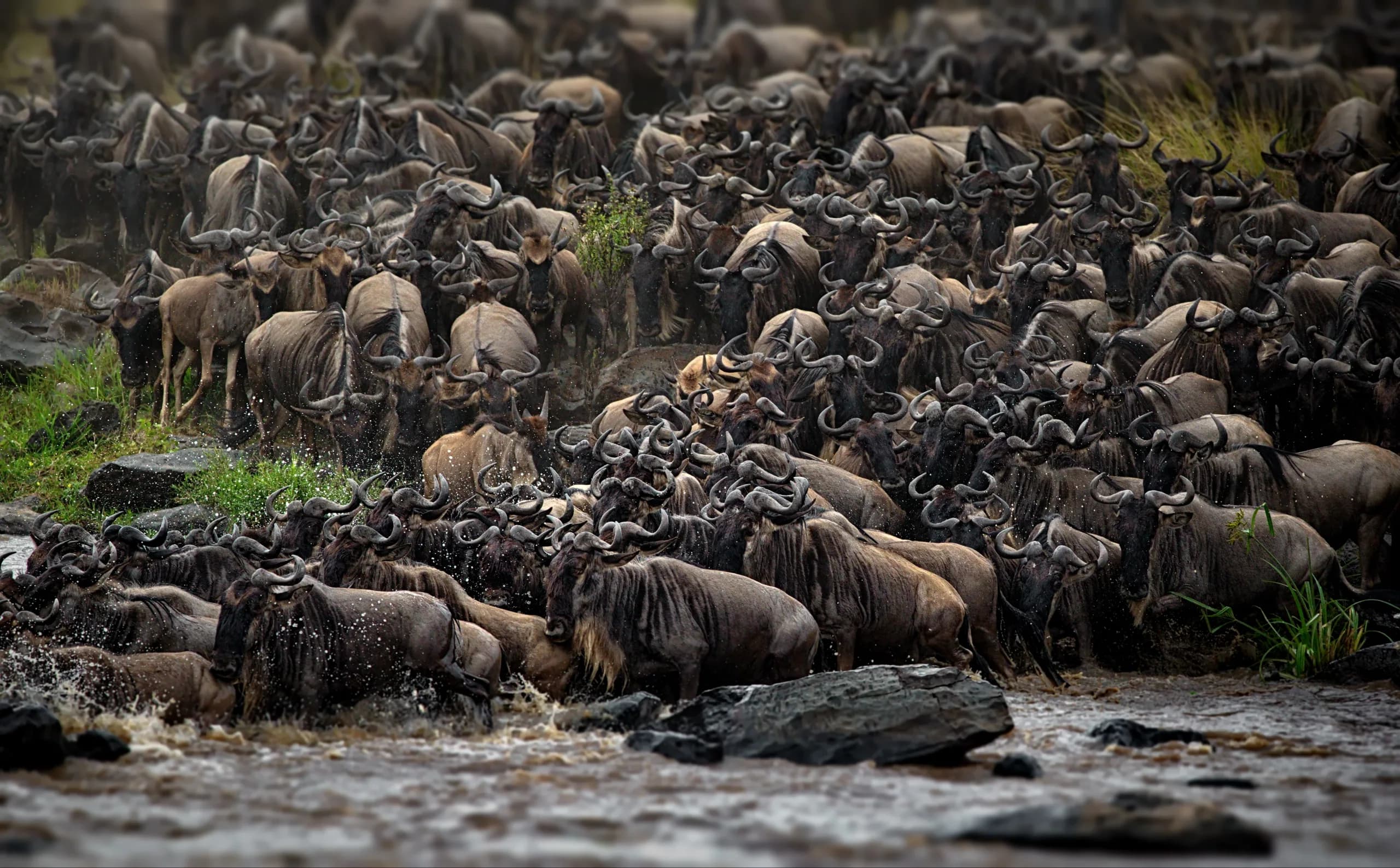
The greatest show on earth
Two million animals, one endless circle.
The Great Migration is not an event you book for a Tuesday. It is a year-round circuit across the Serengeti and the Masai Mara, and knowing where it will be, and when, is the whole craft.
It is a circle, not a date.
Around two million wildebeest, zebra and gazelle move in a vast clockwise loop through the Serengeti–Mara ecosystem, following the rain and the grass it brings. They never stop. There is no off-season for the herds, only an off-season for being in the wrong place.
This is why the single most valuable thing we do is match your travel dates to the right piece of the circuit. Tell us when you can go, and we will tell you where the herds should be, then build the camps around that rather than the other way round.
The calving season, January to March.
In the short-grass plains of the southern Serengeti, close to half a million calves are born in a window of a few weeks. It is the most concentrated birthing event on the planet, and it draws every predator for miles.
For many travellers this is the better half of the migration: the drama is constant, the plains are open, the light is extraordinary, and the crowds are a fraction of what the river crossings attract.
The river crossings, July to September.
This is the image everyone carries: the herds massing on the bank of the Mara River, hesitating, then pouring across through the current and the crocodiles. It happens in the northern Serengeti and the Masai Mara, usually between July and September.
We will be straight with you about it. Crossings are unpredictable. Herds can wait at the bank for hours or days, and then cross somewhere else entirely. The travellers who come away happiest are the ones who gave it time, and who understood that the waiting is part of the thing.
Straight answers
What people ask us.
- When is the best time to see the Great Migration?
- It depends what you want to see. For the river crossings, July to September in the northern Serengeti and Masai Mara. For the calving season and heavy predator action, January to March in the southern Serengeti. Both are extraordinary; neither is more 'real' than the other.
- Can you guarantee I'll see a river crossing?
- No, and we would distrust anyone who did. The herds cross when they decide to. What we can do is put you in the right region at the right time, in a camp close to the crossing points, with a guide who reads the signs, and give you enough nights that the odds fall firmly in your favour.
- Serengeti or Masai Mara for the migration?
- They are one ecosystem split by a border, and the herds use both. The northern Serengeti tends to be quieter with fewer vehicles at a crossing; the Mara is easier to reach and superb from roughly August. Many of our travellers do both in one trip.
Tailor-made
Follow the herds properly.
Give us your travel window and we will tell you exactly where the migration should be, and build the expedition around it.